SPIN ESR 2.3: Next-Generation Physics-based earthquake forecasts
Name: Foteini Dervisi 
Institution: British Geological Survey (BGS)
Email: fdervisi@bgs.ac.uk
Introduction
My name is Foteini (pronounced Fotiní) and I’m from Thessaloniki, Greece. I graduated from the Aristotle University of Thessaloniki with an integrated master’s degree in Electrical and Computer Engineering and I also hold a master’s degree in Artificial Intelligence and Data Analytics from the University of Macedonia. After conducting research in wireless communications, non-intrusive load monitoring and machine learning both in academic and industry environments, I joined the SPIN ITN in October 2022 as an early-stage researcher at the British Geological Survey in Edinburgh and a PhD student at the University of Edinburgh. My PhD project concerns the development of machine learning based earthquake monitoring and forecasting workflows. I am excited to embark on this PhD project as it is a project at the intersection of machine learning, which is my area of expertise, and geosciences, which is a field that I am keen to delve into. During my free time I enjoy going for walks, playing tennis, cooking and reading.
Publication
F. Dervisi, M. Segou, P. Poli, B. Baptie, I. Main, and A. Curtis, “Towards a deep learning approach for short-term data-driven spatiotemporal seismicity rate forecasting,” Earth, Planets and Space, vol. 77, no. 185, 2025. [Online]. Available: https://link.springer.com/article/10.1186/s40623-025-02241-6
F. Dervisi, M. Segou, B. Baptie, P. Poli, I. Main, and A. Curtis, “Explainable artificial intelligence for short-term data-driven aftershock forecasts.” In EGU General Assembly Conference Abstracts, pp. EGU25-9795. 2025.
F. Dervisi, M. Segou, B. Baptie, I. Main, and A. Curtis, “Towards a Deep Learning Approach for Data-Driven Short-Term Spatiotemporal Earthquake Forecasting.” In EGU General Assembly Conference Abstracts, p. 17178. 2024.
F. Dervisi, G. Kyriakides, and K. Margaritis, “Evaluating Acceleration Techniques for Genetic Neural Architecture Search,” in Engineering Applications of Neural Networks, L. Iliadis, C. Jayne, A. Tefas, and E. Pimenidis, Eds. Cham: Springer International Publishing, 2022, pp. 3–14. [Online]. Available: https://link.springer.com/chapter/10.1007/978-3-031-08223-8_1
A. K. Vavouris, F. D. Dervisi, V. K. Papanikolaou, P. D. Diamantoulakis, G. K. Karagiannidis, and S. K. Goudos, “An Energy Efficient Modulation Scheme for Body-Centric Terahertz (THz) Nanonetworks,” Technologies, vol. 7, no. 1, 2019. [Online]. Available: https://www.mdpi.com/2227-7080/7/1/14
A. K. Vavouris, F. D. Dervisi, V. K. Papanikolaou, and G. K. Karagiannidis, “An energy efficient modulation scheme for body-centric nano-communications in the THz band,” in 2018 7th International Conference on Modern Circuits and Systems Technologies (MOCAST), 2018, pp. 1–4. [Online]. Available: https://ieeexplore.ieee.org/document/8376563
Research progress
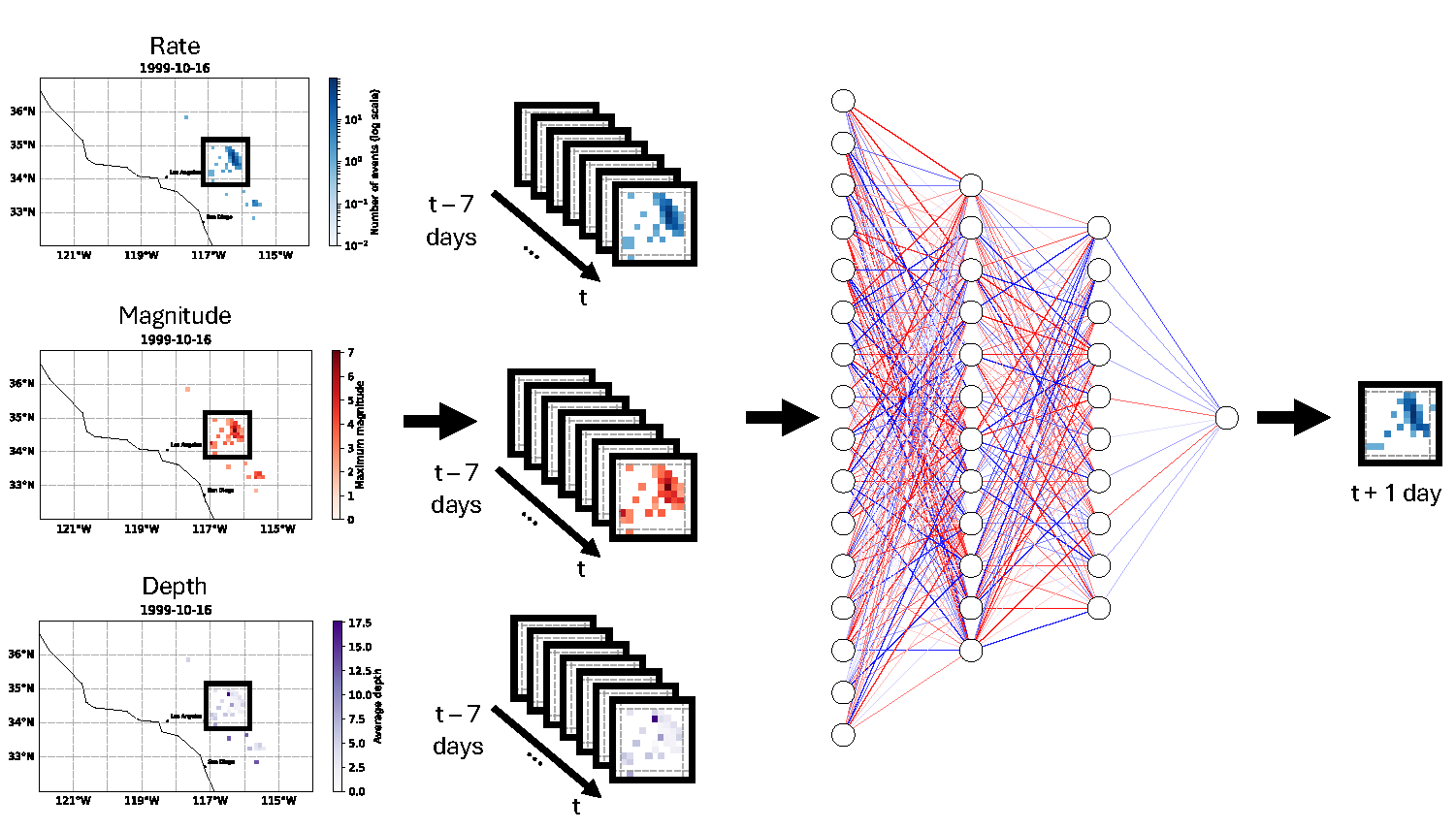 Spatiotemporal rate, maximum magnitude and average depth sequences used to produce next-day rate forecasts. We identify events with magnitude 4 and above, create a square spatial grid around them and produce deep learning-based next-day rate forecasts using the rate, maximum magnitude and average depth maps of the previous 7 days as input. The neural network visualisation was created using http://alexlenail.me/NN-SVG/. BGS © UKRI 2025. Source: F. Dervisi et al. (2025), Earth, Planets and Space. Available at: https://link.springer.com/article/10.1186/s40623-025-02241-6. Licensed under CC BY 4.0.